
How to Play Doodle Crash
The complete beginner-to-advanced guide for doodle-crash — the provably fair platform-jumping crash game. Covers every field size, every button, paytable multipliers, fake platform mechanics, and SHA-256 Provably Fair verification. Every mechanic in this guide was tested hands-on across all five field configurations.

Use this How to Play Doodle Crash rules page as a warm-up before you play. Start with the objective, then check which controls affect risk, and only after that look at bet sizing or bonus notes. That order keeps the game from feeling rushed: you know what must happen in a round, what can interrupt it, and which decisions are actually yours.
The best way to learn is to run a short demo routine before real stakes. Play a few low-pressure rounds, notice where you hesitate, and keep the same bet size while you build confidence. That small amount of repetition makes the interface feel familiar before money is involved.
For real-money sessions, set a budget and a stop point before the first round. With those guardrails in place, How to Play Doodle Crash becomes easier to read, easier to pause, and a lot more enjoyable over time. Keep notes simple.
Doodle Crash: Game Description & Core Concept
Doodle Crash is a provably fair platform-jumping crash game built in a notebook-style aesthetic. The game presents a rectangular grid divided into rows (levels) and columns. A purple creature begins at the base of the grid and jumps upward level by level. On every single level across all five field sizes, exactly one platform is fake — hidden from the player until the creature attempts to land on it. The player's goal in doodle-crash is to climb as many levels as possible and collect the growing multiplier before the creature hits that hidden fake platform.
What distinguishes doodle-crash from passive crash games is the decision-making at every step. Each time the creature successfully clears a level, the current multiplier increases and the COLLECT button becomes live. Players must decide: take the guaranteed win now, or risk the next jump for a higher payout. The tension between greed and caution is the entire soul of doodle-crash. With a Published RTP of 95.83%–96.26% (average 96.05%), a house edge of 3.74%–4.17%, and five distinct field sizes offering maximum multipliers from x7.68 to x14.79, doodle-crash delivers a transparent and decision-driven experience not available in traditional slot games.
The game runs in HTML5 on all modern browsers without any download. Doodle Crash is compatible with desktop computers (Windows, macOS), iOS (Safari), and Android (Chrome). Version 1.0.4 — with rules dated 06.07.2023 — is the current official release and includes the full five-field menu, the Provably Fair history viewer, and all six interface buttons described in this guide.
Doodle Crash Quick Reference
| Game Type | Crash game (platform-jumping, notebook style) |
| RTP Range | 95.83% – 96.26% |
| Average RTP | 96.05% |
| House Edge | 3.74% – 4.17% |
| Maximum Win | x14.79 (6x15 field) |
| Minimum Bet | 0.10 |
| Field Sizes | 2x3, 3x6, 4x9, 5x12, 6x15 |
| Fake Platforms | 1 per level (hidden until jumped) |
| Provably Fair | Yes (SHA-256) |
| Game Version | 1.0.4 (rules dated 06.07.2023) |
| Platform | Web browser (HTML5), iOS, Android |
Step-by-Step Guide: Playing Your First Round of Doodle Crash
Playing doodle-crash follows a straightforward four-stage cycle: choose your field, place your bet, start the round, and decide when to collect or continue. This section walks through each stage in detail so your first real-money round has no surprises.
Step 1 — Choose Your Field Size
Before placing a bet in doodle-crash, press the FIELD button to open the field size selection menu. Five grid configurations are available, each with a different column count, level count, and maximum multiplier. The field size you choose determines how many columns of platforms appear per level (more columns = fewer fake-to-safe ratio per jump = lower per-jump risk) and how many levels exist before the maximum multiplier is reached.
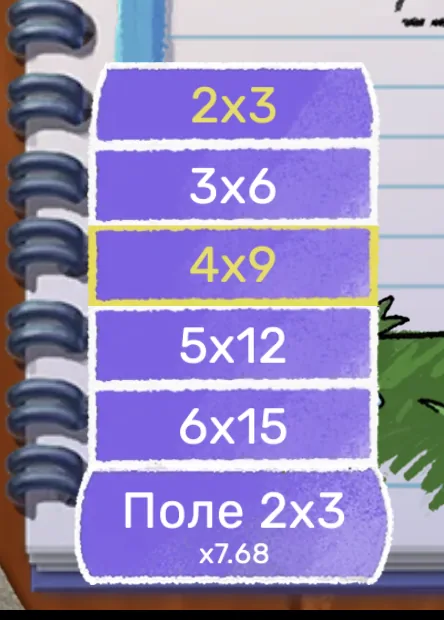
If you are new to doodle-crash, start with the 4x9 or 5x12 field. These mid-range grids offer a per-jump fail chance of 25% and 20% respectively — balanced enough to experience multiple levels without the extreme difficulty of the 2x3 field (50% fail per jump).
Step 2 — Set Your Bet
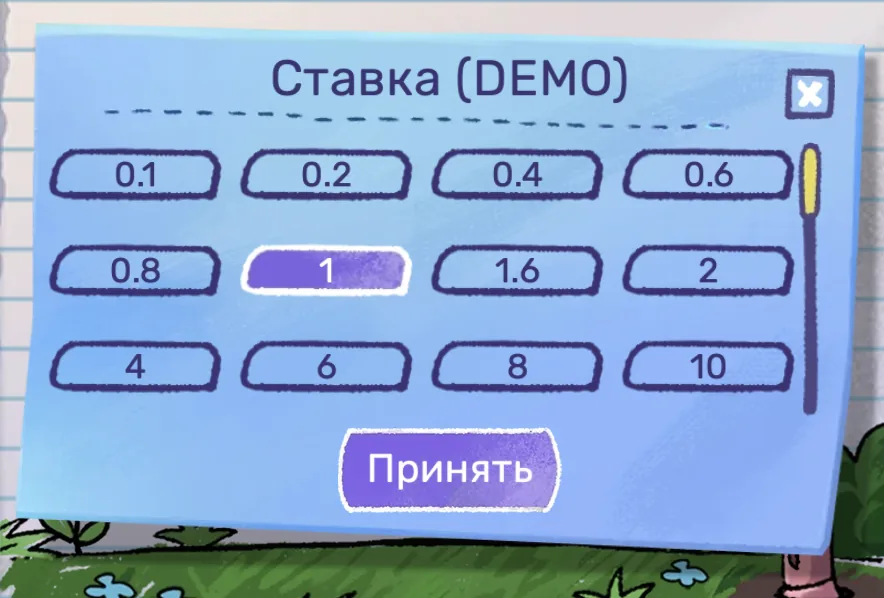
After selecting a field size, use the bet input area to set your wager for the round. The minimum bet in doodle-crash is 0.10. Your bet is the base figure that all multipliers are applied to. A x5.00 multiplier on a 1.00 bet pays 5.00; on a 0.10 bet it pays 0.50. There is no autobet or continuous spin in doodle-crash — every round requires a manual bet confirmation.
Step 3 — Press START
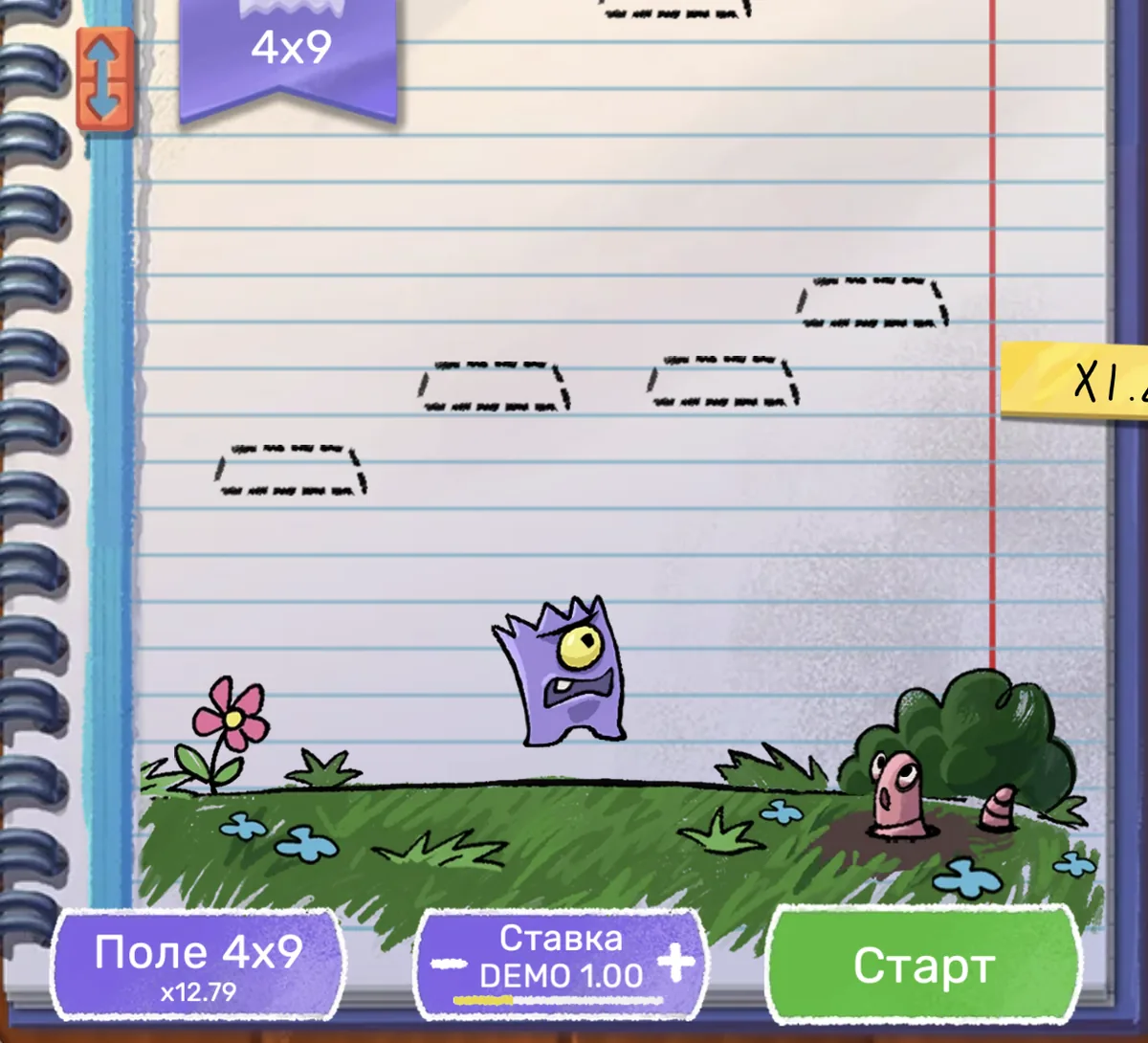
Once your field size and bet are confirmed, press the START button. The doodle-crash grid activates, the purple creature appears at the bottom row, and the first level of platforms becomes interactive. At this point, the SHA-256 hash of the round outcome has already been committed by the server — what happens next is cryptographically fixed and verifiable.
Step 4 — Jump Across Platforms
Click or tap a platform on the current level to make the creature jump. The creature will land on the platform and either:
- Succeed: The platform was safe. The current multiplier increases and the next level opens. The COLLECT button is now live.
- Fail: The platform was fake. The creature falls, the fake platform is revealed, and the round ends with a total loss of the bet.
Alternatively, press RANDOM to have the game automatically select a platform using the same SHA-256 process. Random selection does not change the underlying probability — it simply removes the manual choice.
Step 5 — COLLECT or Continue
After every successful jump in doodle-crash, you face the core decision: press COLLECT to take the current multiplier and win, or jump to the next level for a higher payout. The multiplier grows with each successful level. The risk grows equally — there is always exactly one fake platform per level, and its position resets unpredictably at each row.
There is no partial collect in doodle-crash. You either collect everything at the current multiplier or risk everything on the next jump. Reaching the final level of the grid and surviving pays the maximum multiplier for that field size.
Field Sizes Explained: All Five Doodle Crash Grids
The field size is the most consequential decision in doodle-crash. Every field creates a completely different risk-reward profile by changing the number of columns per level (which sets the per-jump fail probability) and the number of levels (which sets the maximum multiplier). Understanding all five fields is essential before playing doodle-crash for real money.
The fail probability per jump on any field equals 1 divided by the number of columns. On the 2x3 field with 2 columns, there is a 1-in-2 chance (50%) of hitting the fake platform on any single jump. On the 6x15 field with 6 columns, the per-jump fail chance drops to 1-in-6 (16.7%). However, a taller field requires surviving more jumps, so the cumulative risk of reaching the maximum multiplier increases with field height regardless of per-jump probability.
| Field Size | Columns | Levels | Fail % Per Jump | Max Multiplier | Profile |
|---|---|---|---|---|---|
| 2x3 | 2 | 3 | 50% | x7.68 | Very High Risk / Low Levels |
| 3x6 | 3 | 6 | 33.3% | x10.94 | High Risk / Medium Levels |
| 4x9 | 4 | 9 | 25% | x12.79 | Medium Risk / Balanced |
| 5x12 | 5 | 12 | 20% | x13.97 | Lower Risk / Many Levels |
| 6x15 | 6 | 15 | 16.7% | x14.79 | Lowest Per-Jump Risk / Most Levels |
2x3 Field — Maximum x7.68
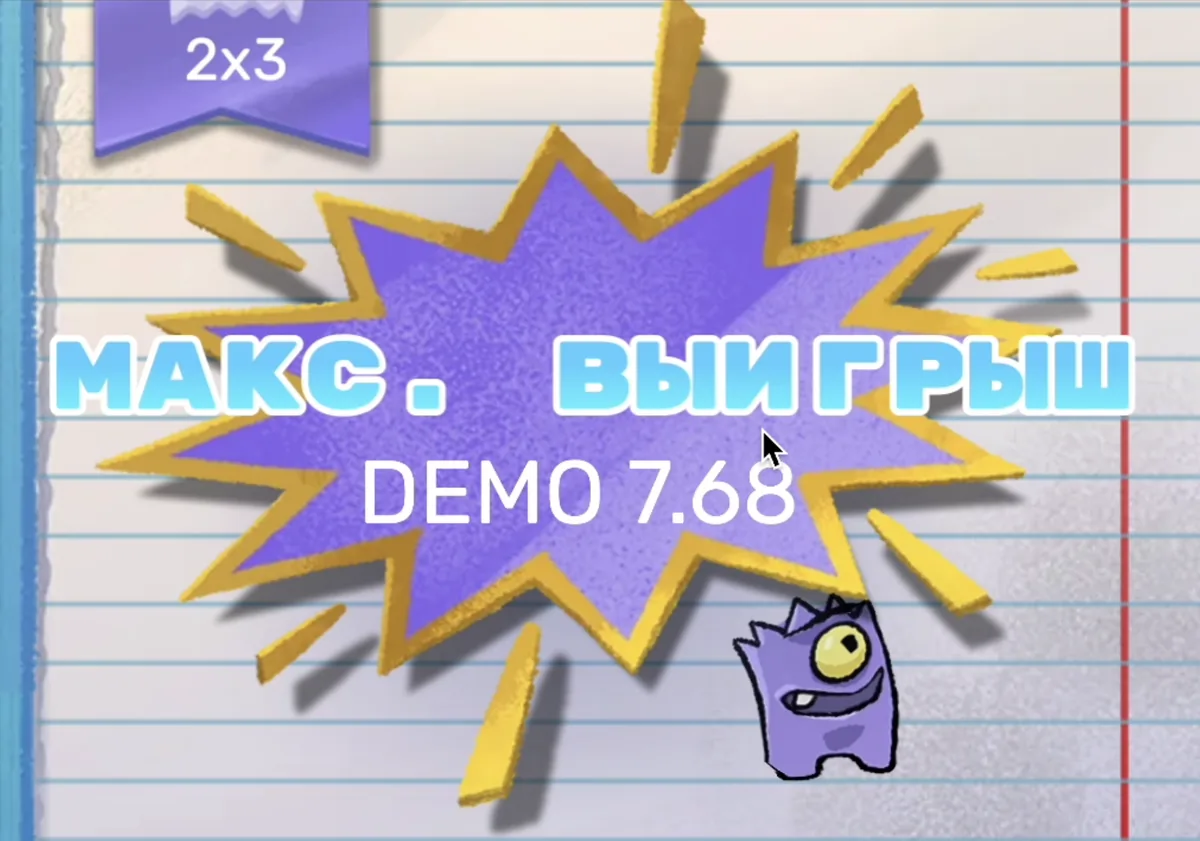
The 2x3 field in doodle-crash has 2 columns and 3 levels. With only two platforms per level, there is exactly a 50% chance of choosing the fake platform on every single jump. This field offers the lowest maximum multiplier (x7.68) but requires only three successful jumps to reach it. The 2x3 field is effectively a coin-flip game three times in a row — high drama, fast resolution.
3x6 Field — Maximum x10.94
The 3x6 field expands to 3 columns and 6 levels in doodle-crash. A 33.3% per-jump fail rate still carries significant risk, but the six-level structure enables a meaningful multiplier progression. Early collection after 2–3 levels on the 3x6 field produces modest multipliers, while surviving all six levels pays x10.94.
4x9 Field — Maximum x12.79
The 4x9 field is widely regarded as the balanced option in doodle-crash. Four columns per level give a 25% fail chance per jump — one in four — which is manageable enough to build comfortable mid-game multipliers before committing to the upper levels. The nine-level structure and x12.79 ceiling make this the most commonly chosen field for players balancing risk and reward.
5x12 Field — Maximum x13.97
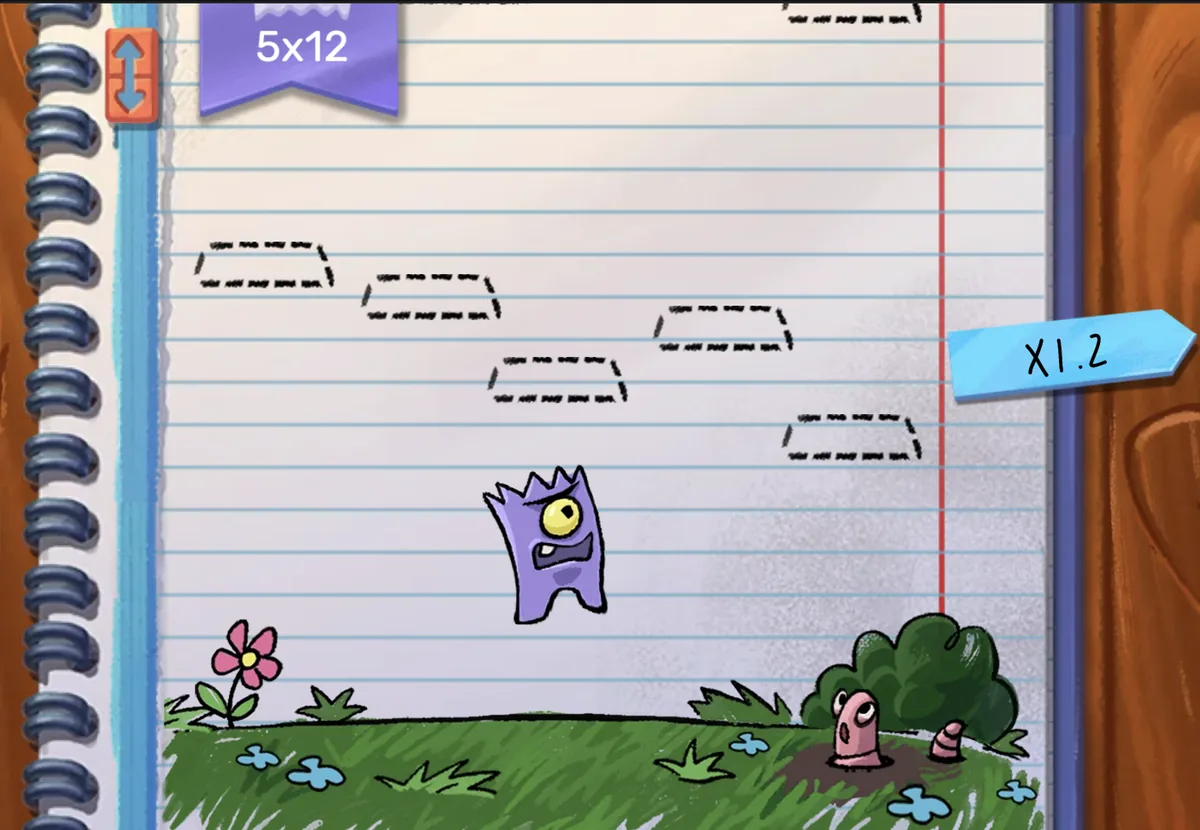
The 5x12 field offers 5 columns and 12 levels. A 20% per-jump fail rate means statistically four of every five jumps succeed. The twelve-level progression builds multipliers gradually, and early-collection windows appear frequently. The x13.97 maximum is close to the game's theoretical ceiling and requires surviving 12 consecutive jumps.
6x15 Field — Maximum x14.79
The 6x15 field is doodle-crash's widest and tallest configuration. Six columns create a 16.7% per-jump fail rate and 15 levels must be climbed to reach the x14.79 maximum win. While each individual jump is the safest in the game, the sheer number of required levels makes full completion statistically rare. The 6x15 field suits players who prefer a gradual multiplier climb with frequent early-exit opportunities.
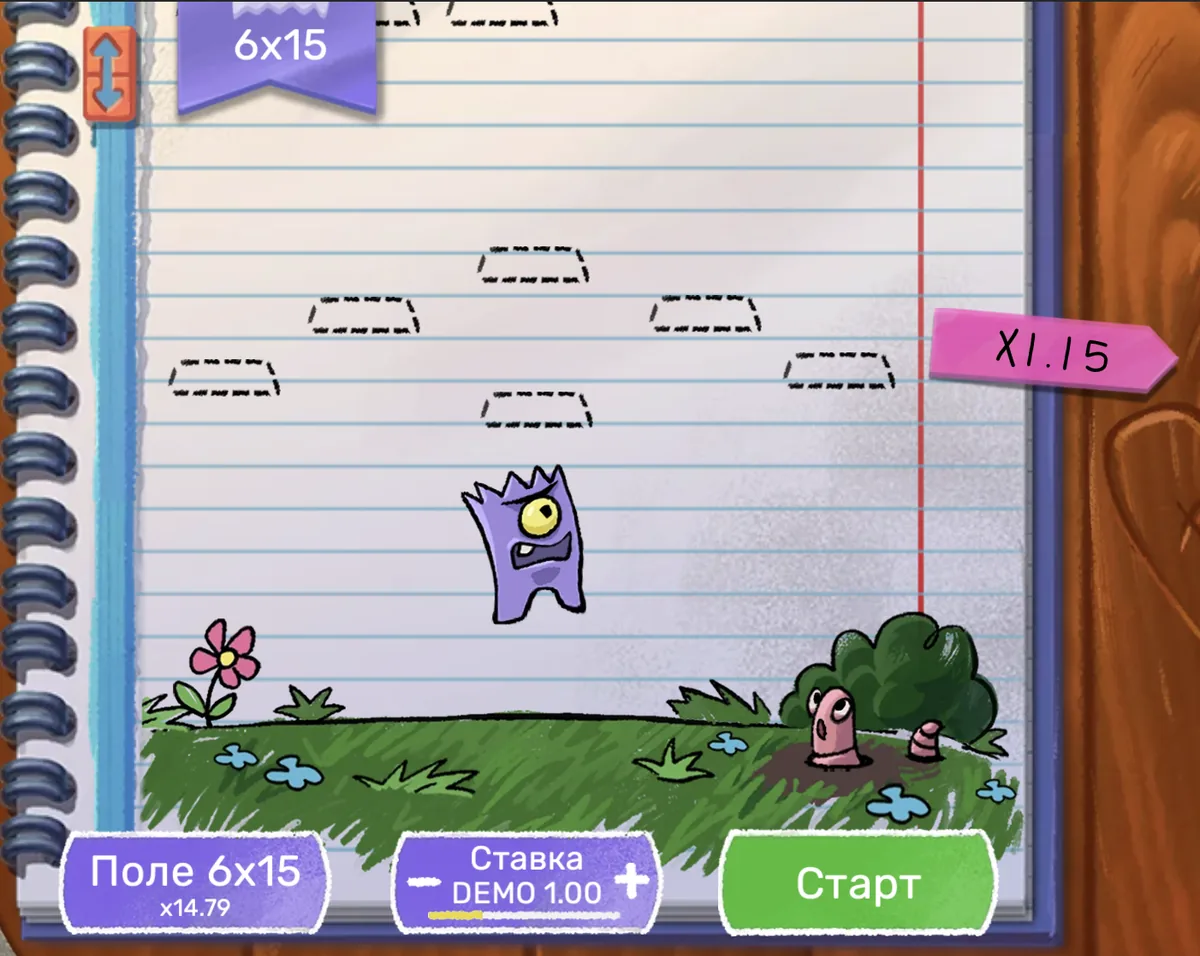
Button Guide: Every Control in Doodle Crash Explained
Doodle Crash has six primary interface buttons. Knowing what each button does before your first real-money session prevents confusion during critical collect-or-continue moments. All buttons are visible in the main game interface at all times.

FIELD
The FIELD button opens the field size selection menu. Pressing FIELD displays all five grid options (2x3, 3x6, 4x9, 5x12, 6x15) alongside their maximum multipliers. You can only change the field size between rounds — once START is pressed and a round is active, the field cannot be switched. The FIELD button is accessible at all times in the lobby state.
START
The START button initiates a round of doodle-crash. Pressing START locks in your current bet and field size, generates the SHA-256 hash commitment for the round, activates the grid, and places the creature at the first level. The START button is only active when a valid field size and bet amount are confirmed. Once a round is active, START transforms into the active round state and is not available until the round ends.
COLLECT
The COLLECT button ends the current round and pays out the multiplier accumulated so far, multiplied by your bet. COLLECT becomes available after the first successful jump. At any point during a live round, pressing COLLECT immediately stops the round and credits your winnings. COLLECT is the only way to guarantee a win in doodle-crash — jumping without collecting always carries the risk of hitting the fake platform at the next level.
RANDOM
The RANDOM button automates platform selection for the current level. Instead of clicking a specific platform manually, RANDOM uses the SHA-256 provably fair process to choose a platform. The outcome is statistically identical to manual selection — RANDOM does not improve or reduce your probability. It is useful for players who prefer not to consciously choose a platform, or for fast-play sessions where manual clicking is slower than desired.
MENU
The MENU button opens the game's main settings and history panel. From MENU, players can access the full round history (including bets placed, outcomes, multipliers won, and Provably Fair data), adjust game settings such as sound, and navigate to the paytable or rules section. MENU is available at all times including during a live round, though the game continues independently if MENU is opened mid-round.
HASH
The HASH button provides direct access to the Provably Fair verification data for the most recently completed round. Pressing HASH displays the server seed hash, client seed, and nonce for that round, along with instructions for independently verifying the result using any SHA-256 calculator. HASH is the fastest route to verifying a specific round without navigating through the full MENU history panel.
Paytable & Multipliers in Doodle Crash
Doodle Crash does not use a traditional symbol paytable. Instead, multipliers accumulate level by level as the creature climbs the grid. Each level cleared increases the current multiplier by a fixed amount determined by the field size. The paytable in doodle-crash is best understood as a progression table: the longer you survive, the higher the multiplier; reaching the final level of the chosen field pays the maximum multiplier for that field.
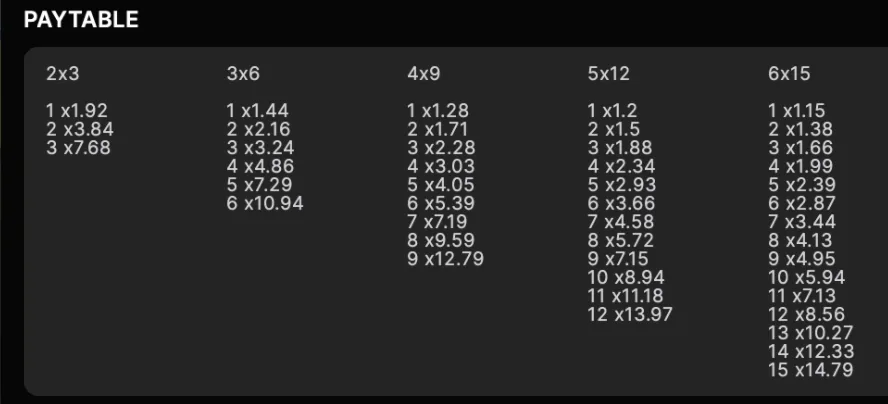
The maximum multipliers for each field size in doodle-crash are fixed values defined in the official game rules (version 1.0.4):
| Field Size | Max Multiplier | Levels to Max | Per-Jump Survival Rate |
|---|---|---|---|
| 2x3 | x7.68 | 3 | 50% |
| 3x6 | x10.94 | 6 | 66.7% |
| 4x9 | x12.79 | 9 | 75% |
| 5x12 | x13.97 | 12 | 80% |
| 6x15 | x14.79 | 15 | 83.3% |
All multiplier payouts in doodle-crash are multiples of the bet placed at the start of the round. A collected multiplier of x5.50 on a bet of 2.00 pays 11.00. If the creature hits the fake platform at any level — even on level 14 of a 15-level field — the entire bet is lost with no partial payout. There are no consolation prizes in doodle-crash for near-misses.
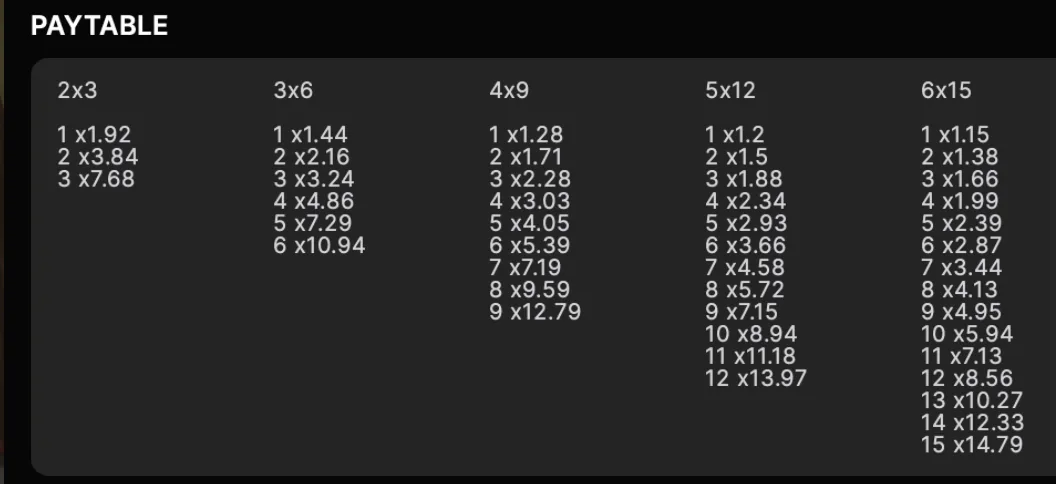
Maximum Win Scenario
The maximum possible win in doodle-crash is x14.79, achieved by completing all 15 levels of the 6x15 field without pressing COLLECT. The creature must survive 15 consecutive jumps, each with a 16.7% fail rate. The probability of completing all 15 levels on the 6x15 field is approximately (5/6)^15 ≈ 6.5%. On a bet of 1.00, the x14.79 payout returns 14.79. Maximum and minimum wins are both achievable at the 0.10 minimum bet.
Loss Screen
When the creature lands on a fake platform at any level, doodle-crash displays the loss screen. The fake platform is revealed visually, the bet is forfeited, and the game returns to the lobby state for the next round. The loss screen also shows the Provably Fair data for that round, allowing instant verification that the outcome was not manipulated.

Provably Fair in Doodle Crash: How SHA-256 Verification Works
Doodle Crash uses SHA-256 Provably Fair technology, making it one of the most transparent crash games available as of 2026. Provably fair means the outcome of every round is cryptographically committed before the round begins — the game cannot change the result after you place your bet, and you can independently verify any round's fairness using widely available tools.

How It Works Step by Step
- Server seed generation: Before the round begins, the server generates a secret seed and creates a SHA-256 hash of that seed. The hash (not the seed) is shown to the player.
- Client seed: The player's client also contributes a seed. Some implementations allow the player to customize their client seed before each round.
- Round commitment: The combined server seed and client seed determine the outcome of all platform positions on the grid for that round. This is fixed before the first jump.
- Round resolution: The creature jumps according to the committed seed. The outcome is exactly as predetermined — no in-game manipulation is possible.
- Verification: After the round ends, the server reveals the original seed. You can apply the SHA-256 hashing function to the revealed seed and confirm it produces the same hash that was shown before the round. If the hashes match, the round was fair.
Accessing Provably Fair Data in Doodle Crash
There are two ways to access Provably Fair data in doodle-crash:
- HASH button: Immediately after any round, press HASH to see the server seed hash, client seed, nonce, and verification instructions for that specific round.
- MENU > History: Open the MENU, navigate to game history, and select any past round to view its full Provably Fair data alongside the bet amount, outcome, and multiplier collected.
The Provably Fair system in doodle-crash applies to every round on every field size. It covers not only which platform is fake at each level, but also the complete path of outcomes that would have occurred if the player had jumped to every level. This means you can verify not just when you lost, but what would have happened if you had continued past the point you collected.
Traditional online casino games use server-side RNGs whose outputs players cannot independently verify. With doodle-crash's SHA-256 Provably Fair system, no post-hoc manipulation is possible — the hash is committed before you bet and independently checkable after. This is a fundamental advantage of doodle-crash over non-verifiable casino games and is particularly relevant when playing for real money at any casino offering doodle-crash.
Game History: Reviewing Rounds, Bets, and Wins in Doodle Crash
Doodle Crash maintains a full session history accessible via the MENU button. The history panel is a key feature for players who want to track their performance, analyze patterns, or verify past rounds using the Provably Fair data attached to each entry. Understanding how to use the history panel helps you make more informed decisions about field size and collect timing in future rounds.
What the History Panel Shows
Every completed round in doodle-crash is recorded with the following data:
- Round number: Sequential identifier for the round within the session.
- Field size used: Which of the five grid configurations was active (2x3, 3x6, 4x9, 5x12, or 6x15).
- Bet placed: The wager amount set before START was pressed.
- Outcome: Win (with multiplier collected) or loss (fake platform hit).
- Level reached: How many levels the creature successfully cleared before the round ended.
- Multiplier: The multiplier value at the point of collection (wins) or at the level where the loss occurred.
- Provably Fair data: Server seed hash, client seed, and nonce for independent verification of that round.
Using History to Analyze Your Session
The history panel in doodle-crash is not a strategy tool — past results have no bearing on future rounds due to the SHA-256 RNG architecture. However, reviewing history is valuable for:
- Tracking your total bets placed vs. total winnings collected across the session.
- Identifying at which levels you typically collect vs. at which levels fake platforms tend to end rounds — useful for understanding your own risk tolerance pattern.
- Verifying any round where the outcome surprised you by accessing the Provably Fair seed data and running it through an external SHA-256 checker.
- Reviewing your collect discipline — whether your actual collect behavior matched your intended strategy for the session.
The doodle-crash history panel shows past rounds, not future probabilities. Seeing several consecutive losses on the 2x3 field does not make a win more likely on the next round. Each round in doodle-crash is independent. Use the history for verification and session tracking, not for betting pattern decisions based on perceived "hot" or "cold" streaks.
Frequently Asked Questions About How to Play Doodle Crash
To start a round in doodle-crash, first press the FIELD button and select a grid size (2x3, 3x6, 4x9, 5x12, or 6x15), then set your bet amount (minimum 0.10), then press START. The purple creature appears at the bottom of the grid and the first level becomes interactive. You can then click a platform manually or press RANDOM to jump. The SHA-256 round hash is committed the moment you press START.
The COLLECT decision in doodle-crash is personal and strategic. There is no universally correct collect point — it depends on your risk tolerance and session goals. COLLECT is available after any successful jump. As a general principle, players with conservative bankrolls often collect at 1.5x–3x multipliers across many rounds, while higher-risk players target 5x–10x before collecting. No collect timing eliminates the house edge of 3.74%–4.17%, but collecting consistently at predetermined multiplier targets helps maintain bankroll discipline.
No. In doodle-crash, the field size is locked once you press START to begin a round. The FIELD button is only accessible between rounds. You must complete the current round — either by pressing COLLECT or by hitting a fake platform — before selecting a new field size. Plan your field choice before placing your bet each round.
The RANDOM button in doodle-crash selects a platform automatically at the current level using the game's SHA-256 Provably Fair algorithm. It does not give you a statistical advantage or disadvantage compared to choosing a platform manually — the per-jump fail probability is identical. RANDOM is useful when you do not want to manually click a specific platform or when you want to remove choice-bias from your play session. The result of RANDOM is part of the same committed seed for that round as any manual jump.
The maximum win in doodle-crash is x14.79, achieved by completing all 15 levels of the 6x15 field without pressing COLLECT. Each of the 15 jumps carries a 16.7% fail rate, making full completion a statistically rare event. On a 0.10 minimum bet, x14.79 pays 1.479. On a higher bet of 10.00, the same x14.79 multiplier pays 147.90. The maximum win applies to every field size — the 2x3 field maximum is x7.68 and requires only 3 levels, but each jump is a 50% coin flip.
After any round in doodle-crash, press the HASH button to access the Provably Fair data for that round. You will see the server seed (now revealed), the server seed hash that was committed before the round, the client seed, and the nonce. To verify: take the revealed server seed, run it through any SHA-256 hashing tool (many free ones exist online), and confirm the resulting hash matches the hash that was displayed before the round started. If they match, the outcome was not altered after commitment. Game version 1.0.4 includes this verification capability built directly into the interface.
Yes. Doodle Crash is built with HTML5 and runs in any modern mobile browser without requiring a dedicated app. The game is fully compatible with iOS (Safari) and Android (Chrome). The interface scales responsively for phone and tablet screen sizes. All six buttons — FIELD, START, COLLECT, RANDOM, MENU, HASH — are accessible on mobile, and all five field sizes are available with the same RTP (95.83%–96.26%) and maximum multipliers as the desktop version.
If you close or refresh the browser during an active doodle-crash round, the behavior depends on the casino platform you are playing on. Most licensed casinos that offer doodle-crash will either auto-collect at the current multiplier or allow the round to resolve server-side and credit the result when you reconnect. Check the specific casino's terms for their disconnection policy. The Provably Fair data ensures the round outcome cannot be altered regardless of connection state — the result was committed before you started jumping.
Your Learning Path
Five steps to confident play — your current position is highlighted. Follow the sequence, or jump to the step that's most useful right now.
Pre-play checks before opening Doodle Crash
Doodle Crash play guide update for June 23 focuses on the step between reading the rules and opening a live round. The how-to page should make jump timing, multiplier pressure, cash-out discipline, demo access, and mobile route choices understandable before the player sees a deposit button. A good guide does not only say when to tap, cross, climb, or cash out; it also explains what can be checked in demo mode and what belongs to the casino account screen.
Before playing for money, use free rounds to confirm multiplier pace, stop target, stake range, loss limit, and current lobby wording. Then set a small session limit and keep the stake flat even after a failed attempt. Bonus offers should be read outside the game flow for wagering, max bet, eligible games, expiry, KYC, withdrawal review, currency support, and country access. Mobile players should use verified browser play or an official operator app, not copied APK files. Doodle Crash is easier to treat as entertainment when the guide keeps controls, risk, and stopping rules together.